
The AI Journey Is a System, Not a Shortcut
Over the last few months, I've spent a lot of time exploring how businesses are actually trying to adopt AI internally, and one thing has become very clear:
Most companies are not struggling with "what AI tool should we use?"
They're struggling with:
- Fragmented workflows
- Disconnected tools
- Unclear implementation strategy
- Operational inefficiencies
- Governance and security concerns
- Figuring out how AI actually fits into day-to-day execution
The Real Gap
The gap between "trying AI" and operationalizing AI is much bigger than most people realize.
The companies seeing the most value right now are not necessarily the ones chasing every new AI product. They're the ones simplifying workflows, consolidating tooling, and focusing on practical implementation tied to real business outcomes.
From Experimentation to Operational Impact
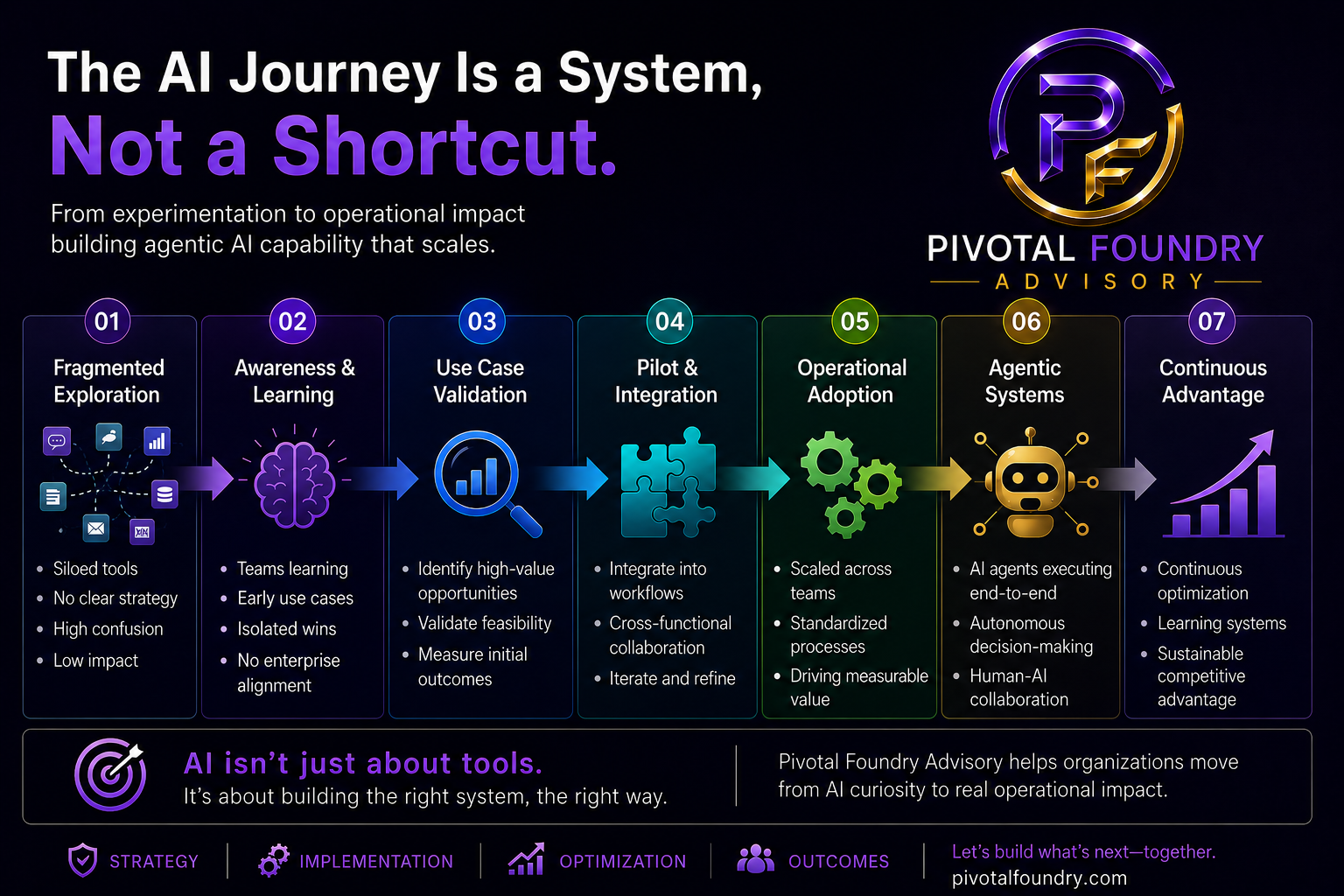
This is something I've been thinking through a lot recently as part of the work at Pivotal Foundry, particularly around AI workflow modernization, operational efficiency, and implementation strategy for SMBs and growing organizations.
The journey from initial exploration to real operational advantage is not a single leap. It moves through distinct phases: fragmented exploration, awareness and learning, use case validation, pilot and integration, operational adoption, agentic systems, and ultimately continuous improvement. Each phase builds on the one before it, and skipping steps is where most organizations run into trouble.
The Conversation Is Shifting
What's been especially interesting is seeing how quickly conversations are shifting from:
"How do we use AI?"
to:
"How do we operationalize it effectively without creating more complexity?"
That shift matters. It signals that organizations are moving past the hype cycle and starting to think about AI as an operational discipline, not just a technology experiment.
Where Companies Get Stuck
From what I've seen, the most common sticking points are not technical. They're structural:
- No clear ownership: AI initiatives get scattered across departments with no central coordination or accountability.
- Tool sprawl: Teams adopt point solutions independently, creating more integration overhead than value.
- Missing process foundation: Automating a broken workflow just produces broken results faster.
- Governance gaps: Security, data privacy, and compliance concerns stall adoption when they're treated as afterthoughts instead of built into the strategy from the start.
AI Isn't Just About Tools
It's about building the right system, the right way. That means connecting strategy to implementation, aligning technology decisions with operational reality, and building capability that compounds over time rather than creating more complexity to manage.
The organizations that will get the most out of AI are the ones treating it as a system to build, not a shortcut to take.